Saturday, December 15, 2007

UC Botanical Garden at Berkeley

On Saturday, I took a trip over to Berkeley for the first time to check out their botanical garden. My brother and his kids came too. There's Peter Jon providing some sense of scale.
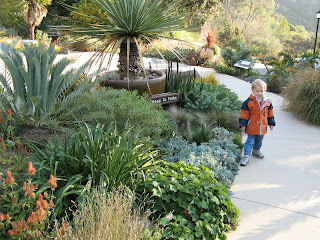
The garden is beautiful and I can't remember ever being more tempted to grow some of the exotic plants of the world. Euphorbia, though often ugly and always poisonous, is a genus that I've considered collecting. Already I have the succulent E. bupleurifolia, E. horrida horrida, and the common E. milii. In the succulent greenhouse there were a few that caught my eye.


Here's the top of the euphorbia above, with some interesting crested Pachipodium behind it.


E. woodii is one of the weirder ones I've seen. E. greenwayi, below, has beautiful patterns on its stems.


When I think of Ericas, I think of the British moor variety. I've never seen one as interesting as this one in the South African collection. It's E. sessiliflora.


In the tropical greenhouse I saw Amorphophallus titanum, the plant with the world's largest unbranched inflorescence (not flower because it's actually made up of many many flowers). You can see the huge spadix, which sports tons of orange/red fruit.


This plant deserves mention because it is the most colorfully-fruited sedge I've ever seen. It's Carex baccans.


And while we're in the sedge family, I should point out this giant Ghania sp. from New Zealand.


Here's the CA native, Coreopsis gigantea, out of its summer dormancy, with some silver Dudleya spp.


The CA garden was nice too. There were beds of native bulbs, an alpine area, and many other wonders. Not only were the collections nice, but it was apparent that the plants are well cared for. I reccomend a visit.


Wednesday, December 12, 2007

Planting for Insect Diversity


Over at Garden Rant, Doug Tallamy comments on native versus non-native plants in the garden for the sake of insects. Most valuable bit: a tree or shrub hosts WAY more insect species than any herbaceous perrenials does. As we all know, when you host insects, you host almost everything else (including birds). So plant those native shrubs and trees! For me, promoting local biodiversity is one of the main reasons to garden. Here's the link.

I haven't done any surveys, but Scrophularia californica (above) has to be one of the best herbaceous perrenials for attracting insects. It bears hundreds of tiny nectar-rich blooms nearly the whole year round and the bees, bee-like flies, and hover flies know it.


Sunday, December 2, 2007

Native Garden Notes from Chuck B.

Chuck B. from Whoreticulture tells of his experiences with NorCal native plant species as a comment to a post at Garden Rant. Here's the link.

Sunday, November 25, 2007

New Trails

Yesterday, I worked on a new segment of the trail with my dad. Eventually, the trail will be a great loop through the property. We keep it simple, with dirt, logs, and leaf-litter mulch.


While we were clearing the ground for the stairs above, I found this weird burly root. I don't know what it is.

My top 2 guesses:

1. Part of a redwood root system, since the trail was below a large redwood

2. Part of a root belonging to Marah oreganus, the Wild Cucumber, also called Coastal Manroot, because it's supposed to have a massive tuber. It also happens to be dormant this time of year and we do have tons of them on the property, so it's possible.

I put it in a pot, so we'll see what comes up.

There are many rewards for traveling down the new segment of the trail, including

mushrooms red as tomatos,


old alders in a skunk cabbage bog (cabbages dormant),


and cool Polypodium scouleri growing on an old stump.


I won't be working on this trail again for some time. Today I followed my brother and his family back down to Woodland, to find my next step. The cab of my truck is loaded with the bare necessities and I'm on the quest to find a cool place to live and work while I think about graduate school or whatever's coming next. (It's going to be tough to garden without some land.) This week I'll be exploring Sacramento, San Francisco, Davis, and Woodland. If nothing feels right, I may head south. I'm going to wing it for a while.

Tuesday, November 20, 2007

CA Native Clovers


Thought about clovers today. If the native Trifolium wormskioldii (Springbank clover) is so cool, what about the other native clovers around here? I haven't noticed any other native clovers in the area, but according to Jepson there are 30 species native to CA (and several subspecies) and possibly 13 of those species are native locally (and are candidates for introduction to the "coastal prairie"). Unlike T. wormskioldii, most of the clovers are annuals, which makes introduction a bit more challenging.

Here are some potentials:

1. T. fucatum (annual) Bull Clover. This is my top choice for introduction because it's beautiful and distintive (see picture above, from CalPhotos). Also, seeds are available from Larner Seeds. Haven't ordered anything yet.

2. T. macraei (annual) Chilean Clover

3, T. microdon (annual) Thimble Clover

4. T. variegatum (annual) White-tipped clover. This one is unbelievable beautiful, based on photos from Calphotos.

5. T. eriocephalum (Perrenial)
If you would like to spend a good chunk of time perusing CA clover diversity, go to the CalPhotos website and type "trifolium" in the scientific name query box. Coupled with the Jepson Manual, CalPhotos is turning out to be a great tool for identifying natives, or just brainstorming what might be interesting to try in a garden.


Saturday, November 17, 2007

Darlingtonia Rescue

Any northern California bog garden wouldn't be complete without that peculiar plant, the Cobra Lily or Darlingtonia californica. Last year I bought and planted one in my bog, on a slight mound so that the crown wouldn't rot. It seemed to have done well, with some new leaves and even a flower this spring, but I found out today that all was NOT well. While weeding around the bog, I noticed white moldy stuff on some of the inner leaves, so I thinned them out to increase air flow. The whole plant rocked back and forth and, sure enough, with the lightest of tugs, I picked up the entire clump. The root system had just been sitting on the mound. Hardly any roots!


I looked more closely at the white moldy stuff. Wasn't sure what that was, but I did find tons of scale.


There's something so repulsing about scale. I dabbed a bit of Ecover dishwashing soap onto an old toothbrush and brushed/washed away what I could.

Then replanted it, all shiny and new, a little deeper. Hopefully that will help it settle in for good. We'll see.


The bog is a bit sparse. I'm still figuring out what to grow with the Darlingtionia. I have some yellow eyed grass, but it's not doing much. If I find a good sward of moss I may lay that down. Smaller plants like bog violets and lady's tresses and maybe a few sundews might be nice, but I don't know how to obtain any local ones, at least not ethically. I may try to collect seed one of these days.

But there's more...

Of course I cut open some of the leaves to see what they had caught.


Lot's of rotting bugs in there. I could recognize beetles, a fly, and even a larva of somekind (Below). The anterior end of the larva fell off as I was opening up the leaf. Nice.

Despite the hassels, it's a cool plant. Eventually, it may be as tall as my knee, may fill the entire bog, and may bloom and seed itself. One can only hope.

Friday, November 16, 2007

Gardening in the Rain

Being unemployed has been really great for the garden. I've done a good fall cleanup and moved some plants around.


Coastal Prairie
I tooks out some weeds, planted large groups of yellow eyed grass along the water course, planted some iris seed, took out a few plants that were in the wrong spot, and tried to think like garden designer, not just a restorationist.


I took a clump of this chartreuse mystery sedge and divided it into five pieces to make a kind of carpet here by the patio. As you can see below, the chartreuse highlights the chartreuse of the calyx of the sticky monkeyflowers nearby. Subtle design, I know, but when you're limitting yourself to natives, and generally to the plants that appear naturally in your yard (the free ones), you take what you get. I'll know the cleverness of the design, if no one else notices. Besides, it's a fun experiment. I may want to add some native bulbs like Triteleia laxa among the sedges, if the area needs some punch.


I cut back lots of the perrenials, including two Penstemon heterophyllous. Just for fun, I cut the material into segments and stuck them in the soil of the prairie here and there, to see if any will be rooted by next spring. Most of the cuttings had two nodes, one leafless and stuck in the ground, the other one left with leaves, unlike the cutting photographed below. I also stuck some in pots. Did the same thing with some mugwort.

Herbs and Water Way
Pictured below, is the path along the south side of the house, which is at the bottom of a solid clay slope (plants are having a real tough time growing there). On the left side we have part of the herb garden and on the right we have the water way that connects to the water course of the coastal prairie. (If you were to walk down the path, you'd see the bog right around the bend.) The herbs are in heavily amended soil (for drainage) and get good light. I cut the lavender back HARD, hand-mowed the thyme carpet, and cleaned up any dead material. On the water way, I removed a bunch of yellow eyed grass, consolidated plants into patches, and hand-mowed the springbank clover carpet, to encourage it to grow lower and thicker, and used the cut pieces to extend the carpet. Eventually I want it to cover the mud you see between the stones and path.


A closer look reveals why I chose springbank clover for this area. Besides being a native and having attractive flowers, I knew this plant could handle the seasonal flooding. I see it growing right along the shores of Big Lagoon.


It also spreads nicely, is edible, has historical significance (was a major food source for local native peoples), and is bright green. And who else gardens with clover?

On the rocks above the clover carpet, all kinds of plants are growing, including a Lilium pardilinum, planted a couple years ago. This week I was bold, and pulled that plant up. The bulbs are amazing.

I divided the bulb into three clumps and rubbed off some of the bulb scales to plant throughout the rocks, especially near the bog. And planted pieces of Mimulus lewisii as companions. My hope is to get more Boykinia elata in there too (right now I only have one).

Forest
As for the forest, I've just been admiring it. The hazel is turning yellow, more mushrooms are popping up, and the big leaf maple has lost its leaves.