Sunday, July 6, 2008
Iris Rootborer
Sunday, May 18, 2008
Coastal Prairie and More
Coastal Prairie
If only the whole prairie looked this full. Sure we have some nice Lupinus polyphyllus, and CA poppies (solid orange, as well as the yellower coastal variety, below)Wednesday, February 13, 2008
Hidden Road to Patrick's Point
You find a narrow mossy path to a native plant garden. You wonder when it was last tended; it's the wildest garden you've seen in a long time. But would you really want to change anything?
Then the forest opens and you see a vast coastal prairie: douglas iris, salal, native blackberry, yarrow, and pacific reed grasses.
You step onto the Rim Trail because you've never been there.
And discover a meadow of sedges just around the corner.
And notice first flowers of spring: salmonberry barely unfurling their petals.
You wander aimlessly. It's imperative to lose yourself for a while.Tthen you can find the trail back home. Here it is: the beach below the sandy cliffs.
You watch as a few dark figures pick through the rocks looking for agates. You ask the ones you pass if they're having any luck. Just small ones. Then you jog home to give your lungs a stretch.
Not a bad place to live, really.
Tuesday, November 20, 2007
CA Native Clovers

Thought about clovers today. If the native Trifolium wormskioldii (Springbank clover) is so cool, what about the other native clovers around here? I haven't noticed any other native clovers in the area, but according to Jepson there are 30 species native to CA (and several subspecies) and possibly 13 of those species are native locally (and are candidates for introduction to the "coastal prairie"). Unlike T. wormskioldii, most of the clovers are annuals, which makes introduction a bit more challenging.
Here are some potentials:
Friday, November 16, 2007
Gardening in the Rain
I tooks out some weeds, planted large groups of yellow eyed grass along the water course, planted some iris seed, took out a few plants that were in the wrong spot, and tried to think like garden designer, not just a restorationist.
I divided the bulb into three clumps and rubbed off some of the bulb scales to plant throughout the rocks, especially near the bog. And planted pieces of Mimulus lewisii as companions. My hope is to get more Boykinia elata in there too (right now I only have one).
Forest
As for the forest, I've just been admiring it. The hazel is turning yellow, more mushrooms are popping up, and the big leaf maple has lost its leaves.
Tuesday, October 30, 2007
Frank Lake's Dissertation
The starting of fires was considered a spiritual act capable of
serious consequences. Prayer formulas and other beliefs were associated with
burning. Once lit, fires were often spoken to as to how they should behave
and conduct themselves to achieve desired resource objectives of the igniter (p.
99).
Patches and fields were located along trails that typically ran adjacent to rivers
and streams, the coast, and along ridgelines, directly connecting communities, peaks,
campgrounds, waterfalls, springs, and other favored subsistence and ceremonial
locations. Fires were also used to clear and maintain trails; rejuvenate berry patches,
wild pea fields, root and bulb fields, and orchards; for hunting; for weed control; and
to cure large fields of tarweed (Madia elegans Lindley) and grass seeds ("Indian
oats"). Daily and seasonal trail clearing activities, combined with seasonal and
occasional brush clearing, hunting, seed curing, and sprout-inducing burns were nearly year-around activities.
meadows traditionally maintained by fire have been lost. One example is at Patrick's Point (between Trinidad and Big Lagoon). When Europeans took over the area, they kept the meadows open with fire and with their cattle. When it was made into a State Park and the ranchers were removed, the spruce and shrubs began moving in. Today I know that there is at least one meadow area that the state burns occasionally to encourage the native prairie
plants.
Indians used fire to clear brush and debris from riparian areas and marshes to
stimulate new grass, plant growth, and shrub and tree sprouts. Target
species were cottonwoods (Populus balsamifera spp. trichocarpa Torrey &
A. Gray), willows (Salix spp.), tules (Scirpus acutus Bigelow var. occidentalis
(S.Watson) Beetle), cattails (Typha latifolia L.), sedges (Carex spp.), and
grasses.
Trails were about two feet wide, worn into bare mineral soil, and served as fire
lines in many cases for low intensity surface fires.
Sunday, October 21, 2007
Humboldt Botanical Gardens
Well, I've been curious ever since about how the gardens are coming. And I have a secret desire to work there, but it's run by volunteers at the moment, I need money, and the driving distance, while not great, is enough to make me be careful about signing up to volunteer.
By chance, I heard the the HBG Foundation was giving a tour of the garden site Saturday (yesterday). It turns out that it was really only open to members, but they kindly let my friend and I tag along and even offered us food and drink. Seems like a nice group of people.
Here's a view of the HBGF meeting with snack table and new greenhouse:
Here's a main pathway leading to a sitting area overlooking the native plant garden.
Native plant garden (one of the few areas planted) with a drain running down the middle. I'm a little concerned that the plantings are too close, but I saw some cool plants down there...
Well, I've skipped over the Moss Family Temperate Woodland garden, which will be packed with rhododendrons (mixed feelings about this), and the Wildberries Riparian area, which is being funded mostly by the Coastal Conservancy to restore and preserve the native willows and such along the creek, to get to a little slice of land that could be most interesting. It's the gardens' coastal prairie. They've planted a bunch of bulbs and native grasses in this area and are trying to beat down the weedy annual grasses by careful mowing. I wonder if they've considered burning or even if it would help agains the weeds. Weedy grasses are tough to control in large areas like this, especially if you can't confidently tell them from the natives. While it's not on the masterplan, I think an area showing the use of native plants, besides purely ornamental, would be nice.
For more info on the gardens, check out this link.
Monday, October 8, 2007
Rushes
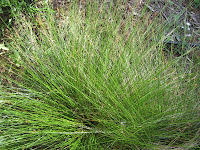
Juncus balticus has fine wiry bright green culms and tiny dark brown flowers that give the garden a speckled look (which I happen to like very much). It grows well in clay and in the coastal prairie.
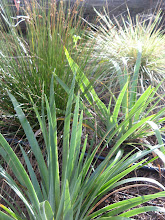
Juncus ensifolius, which has bright green iris-like foliage and black balls of flowers. I sometimes call it Poodle Rush after my mom's little black poodle. It's very ornamental, but can get a bit weedy looking toward the end of the season. It may need to be cut down to the ground each year (I did that laster year and it helped) and it's spreading may also need to be controlled (easy enough in the bog).
This bluish rush is called Juncus patens, or the California Grey Rush. This has a very dark appearance in the landscape and is very rigid and upright. It's flowers are in brown clusters with touches of red and orange.
Then there is Juncus effusus, the softstem rush. This one looks like a more rubust and upright J. balticus, and can get much taller (four feet max?). These bareroot clumps are just sitting in the fountain for the time being, so they're not much to look at.
As you can see in this cross sectional comparison, the culms of J. effusus are also much thicker than J. balticus.
One day I was reading in one of my favorite books, The Once and Future King by T.H. White and he mentioned a "rushlight." Looked it up on wikipedia and read this magazine excerpt and it turns out that old Brits used the pith of J. effusus (yes, it's also native to the British isles) as a wick for candles they called rushlights. Read the magazine excerpt for details. I'd like to try my hand at making rushlights, but I don't have a supply of household grease or bees wax. Not yet anyway.
The green tissue is easy to peel from the pith. The pith, by the way, feels and looks like a spaghetti noodle made of plastic packing foam.
Also in the yard are annual Toad Rushes that are weedy and hairy wood rushes (Luzula spp.) that are also in Juncaceae.
My hope is to encourage everyone to look a bit more closely at "grasses" because there's tons of diversity there. I haven't even gotten to the other graminoids such as the bulrushes, spike rushes, and sedges.