Showing posts with label Old Ways. Show all posts

Wednesday, February 27, 2008

Tsurai


I've been reading a book called The Four Ages of Tsurai, which is a compilation of the European accounts (including one by botanist Archibald Menzies) of the small Yurok village of Tsurai, which was just below the modern town of Trinidad, where I go for internet and library books.

"Olega’ “where they come.” A place near the end of the present wharf which got its name because objects continually drift ashore there."


Trinidad Head is a great place to see plant diversity.

Ribes sanguineum.


The flowers, as you can see, are very beautiful. They're one of the most popular CA natives in cultivation.

I don't know what this litte plant is. Shame.


This is the old lighthouse (but it still lights the way).


Equally exciting is what I can't see.


"Ko’ixkulole’gwo m, “perforated stone where it is covered.” The spot is a cave just below the lighthouse. People took aromatic angelica root (wo’lpei) into the cave and put it into a pool of water in a recess of the cavern. The water would whirl when this was done. If this root (used in many religious and ceremonial connections) was employed by the person in some undertaking,
it would turn out well."


And here's where you get the root, Angelica (lucida?). I wanted to introduce this plant to our property because it's flowers attract pollinators. I had no idea it also attracted luck.


Salal (Gaultheria shallon) is a common plant along the coast. The berries are good in muffins, and have an interesting crunch to them.


This is the silk tassel shrub (Garrya eliptica). The catkins are very showy this time of year and give the whole plant a "mossy bayou" look.


Trinidad Head may be the best place to find Mimulus aurantiacus in this area. I saw it in gardens before I noticed it in the wild. Here's a tiny plant growing on a rock.


Fringecup (Tellima grandiflora) is a common ground cover in the shade, yet we don't have any in Bayside. (Even stranger is our very sparse amount of Oxalis oreganum, the most common redwood forest plant anywhere else.)


There are many beautiful old Ceanothus thyrsiflorus trees here. (They really should be called trees, in Trinidad at least.) They remind me of African accacia trees because of their form and the many little thorn-like branches.


Much of the head is covered in deciduous thickets. Thimbleberry, Twinberry, Blackberry, Gooseberry, and...poison oak.


It seems the Tsurai had a name and story for every rock along the coast. I wonder if today's fishermen have named all the rocks (I bet they have).


Joseph Cambell says, "People claim the land by creating sacred sites, by mythologizing the animals and plants—they invest the land with spiritual powers. It becomes like a temple, place for meditation."

History, hikes, and gardening are great ways to build your temple.

Through intermarriage with whites, disease, and migration to reservations, Tsurai faded away and was completely abandoned by 1914. California has a violent history, especially in respects to the orginal inhabitants. (The Wiyots, the Yuroks southern neighbors who inhabitted Bayside, were massacred nearly to extinction.) But the town of Tsurai faded quietly away.

I haven't confirmed this, but according to the book, the site of Tsurai is grown over, but is marked by a great pepperwood tree (Umbellularia californica).

"If aromatic angelica root was burned beneath its branches and a person prayed for rain, the rain would come in two days...Children were warned to stay away from this tree lest bad luck befall them. If an infant died, the mother...hung the cradle in its branches."

The world is composed of sacred sites.


Sunday, February 3, 2008

Dark Forest Meditation


Susan from Garden Rant said that the Secret Garden was “simply too other-worldly for us to relate to.” But this is exactly the kind of garden I do relate to. And it seems that Piet Oudolf has been making mystical gardens like this for sometime.

What is it about the other-worldly, “dark Forest” gardens that appeals to me, anyway?

At the library, I stumbled upon a book called “The Power of Myth,” which is based on an interview between Bill Moyers and the late scholar of comparative mythology, Joseph Campbell. (I highly recommend it—it seriously reopened my heart to religion.)

I think there are a couple of “dark forest” things going on in my mind.

1. Anima mundi….the animated world, the world full of soul and souls. What do you think about this? Too pagan or romantic for your tastes?

I thought I had uprooted (or at least suspended) my belief in things like God four or five years ago. But to my surprise, beneath my former religion was the simple idea of anima mundi. I don’t even know where I picked this up (and I just found the term for the idea), but I believe it. Sure it’s a romantic idea, that the jay is our brother, that the same spirit runs through all of us, and that we can “Paint with All the Colors of the Wind.” But to me, it means that we are all part of the mystery of life. It means respect and reverence toward the people, animals, plants, and things around us.

2. The Hunter. Something interesting I learned in the Campbell book was that in the land of Canaan the people were farmers and they worshipped a goddess. The Children of Israel were hunters and shepherds and they worshipped the male god, Yahweh, who, according to Campbell, was a war god. It’s not surprising then that the Children of Israel ransacked Canaan, and not the other way around. I’m not a religious scholar. Let me just move onto my point: The farmer and the cowman should be friends. Everything needs a balance of yin and yang, of animal and plant, of masculine and feminine. I think the “dark forest” element in the garden is important to me because it makes the garden more animated, more manly, and, like Ellen said, more visceral.

But there will be no animal sacrifices in the garden.

3. History. I like moss, lichens, patina, ware, rust, and signs of past life, like this chimney on a trail in Petersburg, Alaska (Here with my brother, Peter the Tourist, last summer).


4. Nostalgia. When I was in middle school I was obsessed with the Prydain chronicles by Lloyd Alexander. It was, you know, about a boy who wants crazy adventures, gets caught up in them, wanders the land trying to find himself, finds his ancestry and inner strength, and becomes king. Campbell would have called this the classic hero myth, right up there with The Odysseus, Luke Skywalker, and King Arthur.

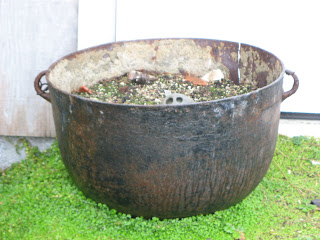
My neighbor's planter reminds me of The Black Cauldron. It could use some plants.


Sunday, January 27, 2008

Expression


Inch for inch, Japanese dry gardens pack a lot of power. But I'm glad that it's contained to a small courtyard because (inch for inch) it's not the greatest space for biodiversity or productivity.

And if it sprawled out, it would lose its magic and become a golf course.

I like a healthy balance of modernism and postmodernism. I like beauty and the sublime, but there is more to life than aesthetics. There are other things to express, and there are means for expression other than color, form and texture. I don't have to limit myself to expressing one thing either (as cool as that focus is in the dry garden).

Here are some of the things I’m trying to express in Bayside:

1. The value and coolness of local biodiversity. Leave a brush pile for the shrews. Encourage the Scrophularia. Call it performance art.

2. The dark forest myth. (It’s not clear why exactly, but this really resonates with me. The surrounding landscape and those fantasy novels I read as a kid are probably responsible.) This, at least in part, is leaving the creepy side of nature intact and the idea of artifacts.

3. Stewardship. Our need of the land, and the land’s need for us. I became a gardener a few years ago to make everything in Bayside look “natural.” I now like the idea of coppices, crops, and compost piles within the wilder landscape. I am especially drawn to traditional land management techniques like burning and coppicing. Sometimes I use a stick to dig my planting holes, no joke. This is partly responsible.

What I’m really trying to express is my idea of paradise. For me, paradise is not just “pretty.” It’s ferociously beautiful, diverse and productive. And I get to live in it.

Tuesday, October 30, 2007

Frank Lake's Dissertation


With a recommendation from Bob Zynbach and help from mmw, I've managed to find and read a disseration by Frank Lake, who wrote it for Oregon State University, and who is Karok. You can find the dissertation here. It's a very long document and I admit that I scanned over parts (especially the methods section), but I found several ideas and details making it worth the read.

About fire:

The starting of fires was considered a spiritual act capable of
serious consequences. Prayer formulas and other beliefs were associated with
burning. Once lit, fires were often spoken to as to how they should behave
and conduct themselves to achieve desired resource objectives of the igniter (p.
99).

A picture of what much of northern California and Southern Oregon looked like:
Patches and fields were located along trails that typically ran adjacent to rivers
and streams, the coast, and along ridgelines, directly connecting communities, peaks,
campgrounds, waterfalls, springs, and other favored subsistence and ceremonial
locations. Fires were also used to clear and maintain trails; rejuvenate berry patches,
wild pea fields, root and bulb fields, and orchards; for hunting; for weed control; and
to cure large fields of tarweed (Madia elegans Lindley) and grass seeds ("Indian
oats"). Daily and seasonal trail clearing activities, combined with seasonal and
occasional brush clearing, hunting, seed curing, and sprout-inducing burns were nearly year-around activities.
There is an interesting series of photographs in the paper showing that many
meadows traditionally maintained by fire have been lost. One example is at Patrick's Point (between Trinidad and Big Lagoon). When Europeans took over the area, they kept the meadows open with fire and with their cattle. When it was made into a State Park and the ranchers were removed, the spruce and shrubs began moving in. Today I know that there is at least one meadow area that the state burns occasionally to encourage the native prairie
plants.


Indians used fire to clear brush and debris from riparian areas and marshes to
stimulate new grass, plant growth, and shrub and tree sprouts. Target
species were cottonwoods (Populus balsamifera spp. trichocarpa Torrey &
A. Gray), willows (Salix spp.), tules (Scirpus acutus Bigelow var. occidentalis
(S.Watson) Beetle), cattails (Typha latifolia L.), sedges (Carex spp.), and
grasses.

At work, I’ve been harvesting bareroot Scirpus microcarpus and water parsley plants. There is quite a bit of grass thatch below, making them difficult to pull up. I use a garden fork and my hands to pull the thatch away from the base of the plants, then use the fork lift the plants. Burning the thatch would save a great deal of time. If it were my nursery and my patches, I might do some experimenting.


I liked hearing about their trails.


Trails were about two feet wide, worn into bare mineral soil, and served as fire
lines in many cases for low intensity surface fires.


There are also many interviews with elder men and women from local tribes. I'm still reading through some of them. But I really should have taken better notes, I know I'm leaving out some important things.


P.S. I'm currently reading Tending the Wild by Kat Anderson.


Monday, October 22, 2007

Hazel

I fell in love with hazel the first time I stumbled upon it in our forest. That was a few years ago, so my plant eyes were just developing. My father and I were cutting a trail and I said to myself, hey this isn't just another alder. No offense, I like alders too.


The leaves of hazel are downy soft, especially in early spring, are more finely toothed than alder, and more ovular. I also really like their arrangement on the skinny flexible stems. Hazels also have very attractive catkins in spring. I think I've seen some female flowers too (they may have just been buds), but I haven't seen any nuts. Never.

In fall, it's especially apparent that our sweet little hazel tree is really a gargantuan thicket probably many hundred of years old. Here's a look at one of it's "stools":


I say "stool" because it is a term associated with coppicing, a woodland management strategy where you cut a shrub or tree to the ground every so often to encourage new vigorous sprouts from the base. Here, I have to put it in quotation marks. Or maybe it should have been a question mark because this may have infact been a thicket coppiced by the Wiyot people at one time. I couldn't find any evidence of burning, but I doubt ashes would still be around because the soil is a mass of compost and moss. How can I tell? And the stools(?) are covered in moss themselves so I just don't know. But because of our land's closeness to the Bay, I think it is very likely their people lived here at one time.


As you can see above, the thicket is pretty extensive and there are at least four or five main stools, and they may be connected (it's difficult to tell because it's a real jungle in there). Which brings me to expressing a quandry I've had since reading Before the Wilderness. I confess that I am a bit on the romantic side about old, mysterious, "dark forest" things, and yet over the last few months, especially after reading BTW, Wendell Berry, and Noel Perry, I'm becoming more and more swayed to the management side. The solution, I know, is to manage some of it and to hang onto some of the truly amazing old things in the forest. Should I do something with this thicket or just enjoy the jungle?.


Monday, October 8, 2007

Rushes

Rushes are plants that most people call grasses, but they're in their own family (Juncaceae), so they're not true grasses (Poaceae). You could call them graminoids (grass-like plants). Most of them live in wetlands, but not all. Here are a few of the kinds growing in the garden.

Juncus balticus has fine wiry bright green culms and tiny dark brown flowers that give the garden a speckled look (which I happen to like very much). It grows well in clay and in the coastal prairie.

(in front of tufted hairgrass)


Juncus ensifolius, which has bright green iris-like foliage and black balls of flowers. I sometimes call it Poodle Rush after my mom's little black poodle. It's very ornamental, but can get a bit weedy looking toward the end of the season. It may need to be cut down to the ground each year (I did that laster year and it helped) and it's spreading may also need to be controlled (easy enough in the bog).


This bluish rush is called Juncus patens, or the California Grey Rush. This has a very dark appearance in the landscape and is very rigid and upright. It's flowers are in brown clusters with touches of red and orange.


Then there is Juncus effusus, the softstem rush. This one looks like a more rubust and upright J. balticus, and can get much taller (four feet max?). These bareroot clumps are just sitting in the fountain for the time being, so they're not much to look at.


As you can see in this cross sectional comparison, the culms of J. effusus are also much thicker than J. balticus.


One day I was reading in one of my favorite books, The Once and Future King by T.H. White and he mentioned a "rushlight." Looked it up on wikipedia and read this magazine excerpt and it turns out that old Brits used the pith of J. effusus (yes, it's also native to the British isles) as a wick for candles they called rushlights. Read the magazine excerpt for details. I'd like to try my hand at making rushlights, but I don't have a supply of household grease or bees wax. Not yet anyway.

The green tissue is easy to peel from the pith. The pith, by the way, feels and looks like a spaghetti noodle made of plastic packing foam.


Also in the yard are annual Toad Rushes that are weedy and hairy wood rushes (Luzula spp.) that are also in Juncaceae.

My hope is to encourage everyone to look a bit more closely at "grasses" because there's tons of diversity there. I haven't even gotten to the other graminoids such as the bulrushes, spike rushes, and sedges.


Sunday, September 30, 2007

Native Horticulture

Native californians have been gardening with california plants for thousands of years. Hmm, maybe I could tap into that knowledge to the benefit of the land and myself.

I've already mentioned coppicing, but how about cultivation practices that improve berry production, seed germination, mushroom production, and what else? (And reducing fire loads in our forests). Knowing when and how much to take. AND how to encourage native biodiversity. I really have everything to learn.

Kat Anderson's "Before the Wilderness" is a book about this idea on a larger, land management level. Haven't read it yet, but it's at my library and hopefully I can get to it this week.

This is one of the most radical and potentially beneficial gardening ideas I can think of. It would strengthen the human/nature relationship and put deeper meaning into a garden.

At least one of the gardeners at Gardener Rant (see link at far right) rants about the idea of the "yardeners," I'm guessing those that want a no maintenance yard, instead of a garden they are actively engaged with. Well, maybe the ornamental garden isn't that far ahead of a "yarden." Maybe the next step would be to pretend there is no fence around our garden and plug our garden into the larger landscape. Blend the line between cultivated and noncultivated a bit. Maybe this is a way that nonnatives, like recent human migrants, broccoli, and what not, can become native. I don't know, these are just the beginnings of thoughts.

Tuesday, September 11, 2007

Coppicing

I see many leggy, ugly, misshapen shrubs. I want to cut it all back and let it sprout. Many people wonder if they can cut off diseased or mostly dead parts of plants, and I tell them yes. The plants will love it. The native plants too. Of course wildlife does like dead branches and things, but for the plant's sake and for the sake of a nice looking garden, pruning is desirable.

Coppicing is the harshest form of pruning. It's cutting the whole plant down to a couple of inches above the soil line, even if the plant looks fairly healthy. It's not for all plants, but it can be useful.

It can rejuvenate an older shrub by forcing it to send out new vigorous shoots. (I've heard many times that coppicing can also extend the life of a shrub/forb/grass.)

Coppicing some trees and shrubs creates a crop of straight sticks for use in basketry, wickerwork, or for other crafts.

It also can be used get a regular supply of conveniently-sized firewood. A regular coppicing cycle (say, coppicing some, not just any, tree species every seven or so years) can produce "five or even ten times as much burnable wood per acre per year as if you wait for mature trees." And the logs can be thin so that they won't need to be split. (This info comes from an essay in Field Days by Roger Swain. I haven't read it, but I've read about it from Last Person Rural by Noel Perrin.)

Coppicing is a tradition found in cultures all over the world including England (chestnut, willow, and hazelnut coppices especially) and the Pacific Northwest (the Yurok coppice many shrubs for basket materials and Philadelphus lewisii for arrow shafts).

So how can I use coppicing to my advantage?

Firewood
I need to find out which native species would be able to handle coppicing AND would be good for burning. Madrone is one of the best woods for burning around here, but I'm not sure it would resprout vigorously enough (plus we only have one on the lot and it's not doing so well). On the otherhand, redwood sprouts like crazy, but I don't think its that great for burning.
Garden Uses
These are species that have brightly colors stems or that are traditionally used.
Cornus sericea
Corylus cornuta
Salix spp.

(The invasive nonnative Cotoneaster is excellent for crafts and coppicing. It's bark is mottled gray and white when old, and the plants, despite every effort, always bounce back...Below is a trellis I made of it for my mother on mother's day. I'm really not crafty, for the record, though I would like to make my own fences and trellis one day.)

For Appearances
I borrowed a book from work today called California Native Plants for the Garden
By Carol Bornstein, David Fross, and Bart O’Brien. I was very pleased with it because it actually has species-specific pruning advice. I can't recall any other native plant book that does. Anyway here's a quick and dirty list I've compiled of the native plants they say you can coppice, supplemented with other species I've heard you can coppice:

Forbs:
California sunflower
Indian mallow
California fuchsia
Penstemons (they cut them down every late fall at The Arboretum at Flagstaff)
Ferns (really helps ragged-looking sword fern)
Mimulus aurantiacus (personal experience)
Graminoids (grasses, sedges, and rushes):
All of them can and should be cut down at the end of the growing season, according to John Greenlee's Encyclopedia of Ornamental Grasses.

Shrubs:
Garrya
Snowberry (every several years)
Western redbud
Cercis betuloides
Cornus sericea
Toyon
Myrica
Philadelphus lewisii (every five years or so)
Ribes sanguineum
Corylus cornuta
Coyote Brush
Salal

(According to Bornstein et al, shrubs that should not be coppiced include manzanitas and ceanothi.)


One plant that probably should be cut back twice a year is the tall herbaceous perrenial, Scrophularia californica (above). It looks horrible except in early spring, but the bees LOVE the flowers. Other insects love this speceis too, telling by all the holes in the leaves. It's really for the wildlife, but I'm going to experiment. I coppiced it last year and it was much bushier. Then it got ugly. Now it's putting on another round of growth and flowers atop it's ugliness. If I had cut it down after it's first wave of flowers it might be looking a whole lot better now.


Anyway, this late fall/winter (when coppicing should be done), I'm going to rejuvenate some of the plants on the lot. The Deschampsia caespitosa definetely has too much thatch. The coyote brushes could be less leggy. Many of the Mimulus aurantiacus plants could be bushier. (Last winter I cut back some of them and atleast one of them REALLY took off (above). Its form is really nice. This picture is from a couple of months ago).

Not all of the plants that can be coppiced, should be coppiced, of course. But if it offendeth thee, cut it off!