Showing posts with label Art. Show all posts

Sunday, September 7, 2008

Making Marks


First there was a weeping beech. Not only is the bark smooth and white (which makes carvings more legible that they would be on say, a black walnut), but the architecture of the tree creates seclusion—a place where one’s not as likely to be caught being a vandal.


To everyone that journeys under its canopy, the tree becomes their place, makes them feel a sense of discovery, that maybe they’re privy to this spot. And it's satisfying finding a curious shaded spot off the beat path after wandering on the sunny, public grounds of the Brooklyn Botanic Garden. It's a nice contrast.


It’s also interesting to see what people (individuals, couples, maybe even groups) carve when no one else is watching. And what do they carve?


Their identities. Some cool designs. The tree has been changed. Cuts are generally unhealthy for a tree. Weakens growth, exposes inner tissues to pathogens…and yet, in my opinion, the bark has become very beautiful. The most beautiful marks are the ones filled in with scar tissue, where the marks have had time to influence the tree’s growth—to become part of the tree. I didn’t feel the need to contribute (perhaps I’m more of a critic than a participant and besides, I like my trees healthy), but I bet the first cut was all it took to get the ball rolling. I wonder when it hit that threshold: when it became a community art project.


Same with this abandoned pumphouse in Manayunk. Brick, lumber, spray paint, human hands, and decay has created a rich texture.


Layers upon layers. Sublime.


(Don't worry, I was not alone. This was on a field trip with a class.)


We humans like to make a mark.

It's contagious.


Wednesday, February 27, 2008

Tsurai


I've been reading a book called The Four Ages of Tsurai, which is a compilation of the European accounts (including one by botanist Archibald Menzies) of the small Yurok village of Tsurai, which was just below the modern town of Trinidad, where I go for internet and library books.

"Olega’ “where they come.” A place near the end of the present wharf which got its name because objects continually drift ashore there."


Trinidad Head is a great place to see plant diversity.

Ribes sanguineum.


The flowers, as you can see, are very beautiful. They're one of the most popular CA natives in cultivation.

I don't know what this litte plant is. Shame.


This is the old lighthouse (but it still lights the way).


Equally exciting is what I can't see.


"Ko’ixkulole’gwo m, “perforated stone where it is covered.” The spot is a cave just below the lighthouse. People took aromatic angelica root (wo’lpei) into the cave and put it into a pool of water in a recess of the cavern. The water would whirl when this was done. If this root (used in many religious and ceremonial connections) was employed by the person in some undertaking,
it would turn out well."


And here's where you get the root, Angelica (lucida?). I wanted to introduce this plant to our property because it's flowers attract pollinators. I had no idea it also attracted luck.


Salal (Gaultheria shallon) is a common plant along the coast. The berries are good in muffins, and have an interesting crunch to them.


This is the silk tassel shrub (Garrya eliptica). The catkins are very showy this time of year and give the whole plant a "mossy bayou" look.


Trinidad Head may be the best place to find Mimulus aurantiacus in this area. I saw it in gardens before I noticed it in the wild. Here's a tiny plant growing on a rock.


Fringecup (Tellima grandiflora) is a common ground cover in the shade, yet we don't have any in Bayside. (Even stranger is our very sparse amount of Oxalis oreganum, the most common redwood forest plant anywhere else.)


There are many beautiful old Ceanothus thyrsiflorus trees here. (They really should be called trees, in Trinidad at least.) They remind me of African accacia trees because of their form and the many little thorn-like branches.


Much of the head is covered in deciduous thickets. Thimbleberry, Twinberry, Blackberry, Gooseberry, and...poison oak.


It seems the Tsurai had a name and story for every rock along the coast. I wonder if today's fishermen have named all the rocks (I bet they have).


Joseph Cambell says, "People claim the land by creating sacred sites, by mythologizing the animals and plants—they invest the land with spiritual powers. It becomes like a temple, place for meditation."

History, hikes, and gardening are great ways to build your temple.

Through intermarriage with whites, disease, and migration to reservations, Tsurai faded away and was completely abandoned by 1914. California has a violent history, especially in respects to the orginal inhabitants. (The Wiyots, the Yuroks southern neighbors who inhabitted Bayside, were massacred nearly to extinction.) But the town of Tsurai faded quietly away.

I haven't confirmed this, but according to the book, the site of Tsurai is grown over, but is marked by a great pepperwood tree (Umbellularia californica).

"If aromatic angelica root was burned beneath its branches and a person prayed for rain, the rain would come in two days...Children were warned to stay away from this tree lest bad luck befall them. If an infant died, the mother...hung the cradle in its branches."

The world is composed of sacred sites.


Saturday, February 9, 2008

TED Talks

Have you heard of TEDtalks? There are some amazing people and ideas here, and it's all free. The website says:

"TED stands for Technology, Entertainment, Design. It started out (in 1984) as a conference bringing together people from those three worlds. Since then its scope has become ever broader.The annual conference now brings together the world's most fascinating thinkers and doers, who are challenged to give the talk of their lives (in 18 minutes). This site makes the best talks and performances from TED available to the public, for free. Almost 200 talks from our archive are now available, with more added each week. These videos are released under a Creative Commons license, so they can be freely shared and reposted."

The speakers are amazingly intelligent and diverse. Gardeners might be interested in Michael Pollan, biologist/technologist Janine Benyus, and photographer Frans Lanting. But be sure to try a few random people. Videos can be found here on their website and at least some of them are on YouTube.

This video of nature photographer Frans Lanting incorporates many things that fascinate me: trilobites, silverswords, euphorbias, the stilt-legged fox from the Pampas, the work of musician Phillip Glass, and the unity of life.

I also enjoyed:

Theo Jansen: Kinetic sculpure "Beach Creatures."

David Gallo: Ocean animals. Amazing.

Sunday, February 3, 2008

Dark Forest Meditation


Susan from Garden Rant said that the Secret Garden was “simply too other-worldly for us to relate to.” But this is exactly the kind of garden I do relate to. And it seems that Piet Oudolf has been making mystical gardens like this for sometime.

What is it about the other-worldly, “dark Forest” gardens that appeals to me, anyway?

At the library, I stumbled upon a book called “The Power of Myth,” which is based on an interview between Bill Moyers and the late scholar of comparative mythology, Joseph Campbell. (I highly recommend it—it seriously reopened my heart to religion.)

I think there are a couple of “dark forest” things going on in my mind.

1. Anima mundi….the animated world, the world full of soul and souls. What do you think about this? Too pagan or romantic for your tastes?

I thought I had uprooted (or at least suspended) my belief in things like God four or five years ago. But to my surprise, beneath my former religion was the simple idea of anima mundi. I don’t even know where I picked this up (and I just found the term for the idea), but I believe it. Sure it’s a romantic idea, that the jay is our brother, that the same spirit runs through all of us, and that we can “Paint with All the Colors of the Wind.” But to me, it means that we are all part of the mystery of life. It means respect and reverence toward the people, animals, plants, and things around us.

2. The Hunter. Something interesting I learned in the Campbell book was that in the land of Canaan the people were farmers and they worshipped a goddess. The Children of Israel were hunters and shepherds and they worshipped the male god, Yahweh, who, according to Campbell, was a war god. It’s not surprising then that the Children of Israel ransacked Canaan, and not the other way around. I’m not a religious scholar. Let me just move onto my point: The farmer and the cowman should be friends. Everything needs a balance of yin and yang, of animal and plant, of masculine and feminine. I think the “dark forest” element in the garden is important to me because it makes the garden more animated, more manly, and, like Ellen said, more visceral.

But there will be no animal sacrifices in the garden.

3. History. I like moss, lichens, patina, ware, rust, and signs of past life, like this chimney on a trail in Petersburg, Alaska (Here with my brother, Peter the Tourist, last summer).


4. Nostalgia. When I was in middle school I was obsessed with the Prydain chronicles by Lloyd Alexander. It was, you know, about a boy who wants crazy adventures, gets caught up in them, wanders the land trying to find himself, finds his ancestry and inner strength, and becomes king. Campbell would have called this the classic hero myth, right up there with The Odysseus, Luke Skywalker, and King Arthur.

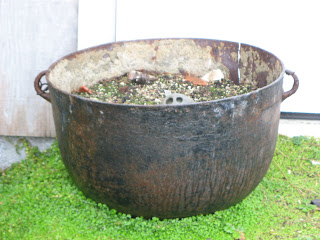
My neighbor's planter reminds me of The Black Cauldron. It could use some plants.


Sunday, January 27, 2008

Expression


Inch for inch, Japanese dry gardens pack a lot of power. But I'm glad that it's contained to a small courtyard because (inch for inch) it's not the greatest space for biodiversity or productivity.

And if it sprawled out, it would lose its magic and become a golf course.

I like a healthy balance of modernism and postmodernism. I like beauty and the sublime, but there is more to life than aesthetics. There are other things to express, and there are means for expression other than color, form and texture. I don't have to limit myself to expressing one thing either (as cool as that focus is in the dry garden).

Here are some of the things I’m trying to express in Bayside:

1. The value and coolness of local biodiversity. Leave a brush pile for the shrews. Encourage the Scrophularia. Call it performance art.

2. The dark forest myth. (It’s not clear why exactly, but this really resonates with me. The surrounding landscape and those fantasy novels I read as a kid are probably responsible.) This, at least in part, is leaving the creepy side of nature intact and the idea of artifacts.

3. Stewardship. Our need of the land, and the land’s need for us. I became a gardener a few years ago to make everything in Bayside look “natural.” I now like the idea of coppices, crops, and compost piles within the wilder landscape. I am especially drawn to traditional land management techniques like burning and coppicing. Sometimes I use a stick to dig my planting holes, no joke. This is partly responsible.

What I’m really trying to express is my idea of paradise. For me, paradise is not just “pretty.” It’s ferociously beautiful, diverse and productive. And I get to live in it.

Friday, January 25, 2008

Collecting Pollen

(not my picture.)

A few years ago in a contemporary art class, I became aware of Wolfgang Laib, a German artist who spends whole days collecting pollen, usually from dandelions. He brings the pollen into museums and puts it in piles on the floor. How unusual.

True, there is something monastic about the look of these piles and his other work that appeals to me. Maybe because I draw with chalky pastels I can appreciate the glow of a simple pile of yellow pigment, but I suspect that there is more magic here.

So I’m thinking…

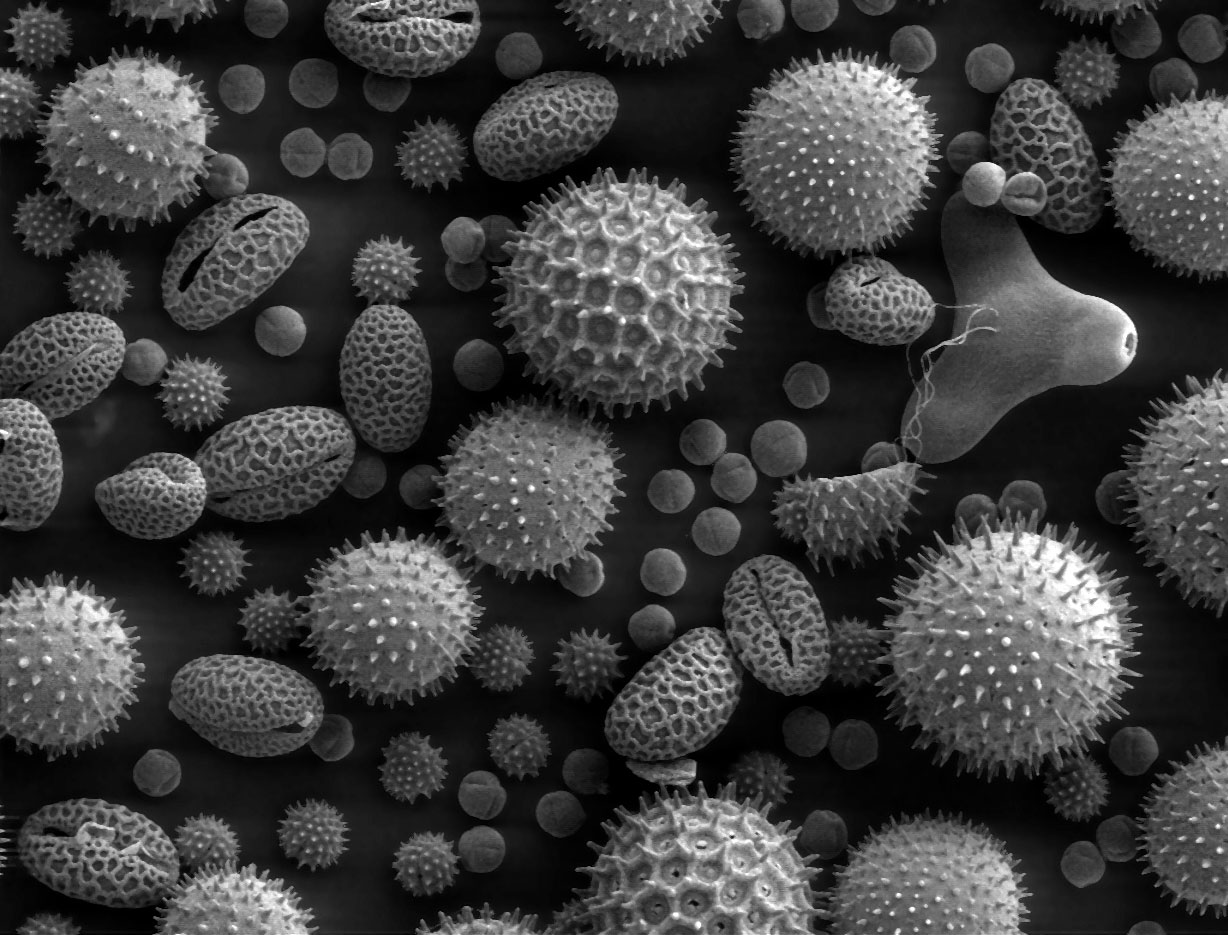
(not my SEM image.)

His piles are actually more than pigment. The mechanics of each grain of pollen is incredible, having emerged from millions of years of evolution. I’m reminded that “simple” pollen, like all life, is much more complex and awesome than the Mona Lisas we usually find in the museum.


After graduation I took an internship at an arboretum in Flagstaff, AZ. I did a variety of work there, and sometimes I spent hours in the wild grasses behind the arboretum collecting their seeds in bags for the collection. I’d just pull them off between my finger and thumb, as I walked by.

There is something so down-to-earth (humble, wholesome, patient) and meditative about tasks like these, and I imagine this is much like collecting pollen. Maybe this is some of the magic he is expressing, the kind of magic that’s easy to lose and forget about these days.


(not my photo.)


While bees feed on pollen (and feed pollen to their young), Laib exhibits and sells pollen to make a living. Maybe the acknowledgement that our lives depend on simple things like plants, air, and soil, and that we tap into these basic sources just like the common bee, is part of the magic.

Luckily we can experience these kinds of magic in the garden. No, not because gardens are full pollen (though I guess it could be). Gardens are places in which we can admire and interact with other life, where we can get back down to earth, and where we can directly tap into the systems that keep us alive (maybe by eating huckleberries from the bush).

Is Laib’s pollen collecting minimalist gardening?