Sunday, October 21, 2007
Ethnobotanical Videos
Thanks to a comment on a post, I've been searching for information about research up in Oregon and stumbled upon these native plant tour videos from 2004. Go to the link for more info.

Humboldt Botanical Gardens
A few years ago, I heard that a botanical garden was being started in Humboldt County. So I went down to College of the Redwoods, who is leasing land nearby for the gardens, to check it out. They had large signs with a master plan of the gardens in front of a large cow pasture--the future site of the gardens. It wasn't much to look at, but the idea was exciting.
Well, I've been curious ever since about how the gardens are coming. And I have a secret desire to work there, but it's run by volunteers at the moment, I need money, and the driving distance, while not great, is enough to make me be careful about signing up to volunteer.
By chance, I heard the the HBG Foundation was giving a tour of the garden site Saturday (yesterday). It turns out that it was really only open to members, but they kindly let my friend and I tag along and even offered us food and drink. Seems like a nice group of people.
Here's a view of the HBGF meeting with snack table and new greenhouse:
 We're walking..

Here's a main pathway leading to a sitting area overlooking the native plant garden.

Native plant garden (one of the few areas planted) with a drain running down the middle. I'm a little concerned that the plantings are too close, but I saw some cool plants down there...

Well, I've skipped over the Moss Family Temperate Woodland garden, which will be packed with rhododendrons (mixed feelings about this), and the Wildberries Riparian area, which is being funded mostly by the Coastal Conservancy to restore and preserve the native willows and such along the creek, to get to a little slice of land that could be most interesting. It's the gardens' coastal prairie. They've planted a bunch of bulbs and native grasses in this area and are trying to beat down the weedy annual grasses by careful mowing. I wonder if they've considered burning or even if it would help agains the weeds. Weedy grasses are tough to control in large areas like this, especially if you can't confidently tell them from the natives. While it's not on the masterplan, I think an area showing the use of native plants, besides purely ornamental, would be nice.

Well, I've been curious ever since about how the gardens are coming. And I have a secret desire to work there, but it's run by volunteers at the moment, I need money, and the driving distance, while not great, is enough to make me be careful about signing up to volunteer.
By chance, I heard the the HBG Foundation was giving a tour of the garden site Saturday (yesterday). It turns out that it was really only open to members, but they kindly let my friend and I tag along and even offered us food and drink. Seems like a nice group of people.
Here's a view of the HBGF meeting with snack table and new greenhouse:
 We're walking..
Here's a main pathway leading to a sitting area overlooking the native plant garden.
Native plant garden (one of the few areas planted) with a drain running down the middle. I'm a little concerned that the plantings are too close, but I saw some cool plants down there...
Well, I've skipped over the Moss Family Temperate Woodland garden, which will be packed with rhododendrons (mixed feelings about this), and the Wildberries Riparian area, which is being funded mostly by the Coastal Conservancy to restore and preserve the native willows and such along the creek, to get to a little slice of land that could be most interesting. It's the gardens' coastal prairie. They've planted a bunch of bulbs and native grasses in this area and are trying to beat down the weedy annual grasses by careful mowing. I wonder if they've considered burning or even if it would help agains the weeds. Weedy grasses are tough to control in large areas like this, especially if you can't confidently tell them from the natives. While it's not on the masterplan, I think an area showing the use of native plants, besides purely ornamental, would be nice.
For more info on the gardens, check out this link.
Thursday, October 18, 2007
Mushrooms
Here in Humboldt County, when mushroom collecting is mentioned people giggle. Ah...what kind of mushrooms?
Edibles
I'm interested in mushrooms I can eat without hallucinating or going to the hospital, so let's set the record straight. So last night I attended the Humboldt Bay Mycological Society meeting with my coworker, Bill, who knows his mushrooms well, to have a look at table displays of various fungi.
These are oyster mushrooms. They grow on dead and dying alders. Could be in our yard...

These are Golden Chanterelles. They have ridges instead of gills. Bill found gallons of them around where he lives, and is making up a big batch of cream of mushroom soup (and he's bringing some into work). He tends to find them growing near spruce trees under evergreen huckleberry and sword ferns. Could be in our yard...

Below are "Lobster Mushrooms." The red color is actually a mold that grows on other mushrooms and I guess it makes them taste good. You just have to be sure that the host is an edible mushroom! Don't know where these grow.

Bill regularly collects about six species of mushrooms and the only one besides the ones above I can remember him collecting is the Chicken of the Forest (sorry, no picture). This is a bright orange frilly shelf fungi that grows on hemlock and doug firs. Only the tips of the frill are soft enough to eat.
Other tips from Bill: Wash wild (and edible, make sure they're edible) mushrooms well under warm water and cook before eating. Steer clear of mushrooms with white gills and rings.
Inedibles
Well, I know these are in our yard.

From left to right: Strobilurus trulisatus, Pholiota terrestris, and the last two are some species of Lepiota. The scientific names of these are sketchy because the handwriting on the labels were pretty bad. (I brought in the mushrooms and had them identified). The Photinia was growing in the coastal prairie. There are also tons of what Bill calls LBMs or Little Brown Mushrooms (not easy to identify).
Well, hopefully tomorrow I'll have a chance to scrounge around the forest to see what I find. Top prize: Golden Chanterelles!
Resources:
California Fungi
Wednesday, October 17, 2007
Before the Wilderness

I've mentioned the book before, but now I'm actually reading it. "Before the Wilderness," compiled and edited by Thomas C. Blackburn and Kat Anderson, is a collection of scientific papers and essays about how native Californians managed the land and how their management altered California and promoted diversity.
While there is much to learn in the book about all parts of California, I've narrowed in on my part, namely, the redwood region, home of a few peoples including the Wiyot and Yurok.
Here are some of the things I'm finding noteworthy (most of it around p. 100):
- Unlike most of CA, tribes of the redwoods relied more on salmon than on agriculture.
- The redwood forest was (and still is, I might add) impenetrable in parts because of massive logs and thickets.. But the natives kept some areas open by burning. And maintained paths connecting these areas. They were also careful about not getting lost in the forest.
- At least one record showed that these open prairies were incredibly valuable for food. Plants with edible seed, such as Wyethia longicaulis, were concentrated in these areas. (I remember seeing swards of Wyethia along the roadside while I was driving to Petrolia. I don’t know what species this was, but this makes me want to collect seed and add it to my coastal prairie). Another account says that these open areas were covered with shrubs, wild oats, edible bulb plants, and clover (springbank clover probably). The largest of these areas were .25 mile by about .75 mile long, and most were much smaller. These areas were frequented by elk and deer too. It’s cool because by maintaining these open patches, elk and deer were drawn to these patches for good forage. So the food came to them.
- Jepson (CA botanist mostly responsible for the Jepson Manual) once said that “There is today more wooded area in
- "In almost every case aboriginal subsistence involved hunting and gathering in two or more vegetational belts." Edges are where you'll find the most diversity, and I guess the most humans.
- Large scale burning, in contrast to patch burning, reduces the total amount of plant and animal production.
- There were, on average, 3-5 people per square mile where I now live.
- Some native people cut the caps off of mushrooms, leaving the “stems behind.”
- Soaproot is more abundant in areas where it is cultivated. Cultivation can be a valuable tool for conservation.
- “There is a common feeling among elders that plants want to be used,” says
- One way to burn an individual coppice stool is to cover it with leaves and set the pile on fire. I wonder if this helps keep out pathogens from eating at the stool. I know one technique of preserving wood posts is to lightly burn the ends.
- Fire is good for huckleberry production (because the shrubs resprout with vigor?)
Monday, October 15, 2007
Blog Action Day

Well, this young blog certainly seems to be going in an environmental direction. It has been and will continue to be a place where I settle myself into the garden/farm/ecosystem complex. I'm in love with the idea of diversity and good stewardship. Where the land, sky and water, and everything in them, belong to us, and we, in turn, belong to them. Let's take care of each other.
Monday, October 8, 2007
Rushes
Rushes are plants that most people call grasses, but they're in their own family (Juncaceae), so they're not true grasses (Poaceae). You could call them graminoids (grass-like plants). Most of them live in wetlands, but not all. Here are a few of the kinds growing in the garden.
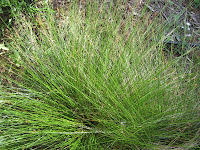
Juncus balticus has fine wiry bright green culms and tiny dark brown flowers that give the garden a speckled look (which I happen to like very much). It grows well in clay and in the coastal prairie.
 (in front of tufted hairgrass)

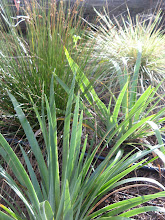
Juncus ensifolius, which has bright green iris-like foliage and black balls of flowers. I sometimes call it Poodle Rush after my mom's little black poodle. It's very ornamental, but can get a bit weedy looking toward the end of the season. It may need to be cut down to the ground each year (I did that laster year and it helped) and it's spreading may also need to be controlled (easy enough in the bog).

This bluish rush is called Juncus patens, or the California Grey Rush. This has a very dark appearance in the landscape and is very rigid and upright. It's flowers are in brown clusters with touches of red and orange.

Then there is Juncus effusus, the softstem rush. This one looks like a more rubust and upright J. balticus, and can get much taller (four feet max?). These bareroot clumps are just sitting in the fountain for the time being, so they're not much to look at.

Juncus balticus has fine wiry bright green culms and tiny dark brown flowers that give the garden a speckled look (which I happen to like very much). It grows well in clay and in the coastal prairie.
 (in front of tufted hairgrass)

Juncus ensifolius, which has bright green iris-like foliage and black balls of flowers. I sometimes call it Poodle Rush after my mom's little black poodle. It's very ornamental, but can get a bit weedy looking toward the end of the season. It may need to be cut down to the ground each year (I did that laster year and it helped) and it's spreading may also need to be controlled (easy enough in the bog).
This bluish rush is called Juncus patens, or the California Grey Rush. This has a very dark appearance in the landscape and is very rigid and upright. It's flowers are in brown clusters with touches of red and orange.
Then there is Juncus effusus, the softstem rush. This one looks like a more rubust and upright J. balticus, and can get much taller (four feet max?). These bareroot clumps are just sitting in the fountain for the time being, so they're not much to look at.

As you can see in this cross sectional comparison, the culms of J. effusus are also much thicker than J. balticus.

One day I was reading in one of my favorite books, The Once and Future King by T.H. White and he mentioned a "rushlight." Looked it up on wikipedia and read this magazine excerpt and it turns out that old Brits used the pith of J. effusus (yes, it's also native to the British isles) as a wick for candles they called rushlights. Read the magazine excerpt for details. I'd like to try my hand at making rushlights, but I don't have a supply of household grease or bees wax. Not yet anyway.
The green tissue is easy to peel from the pith. The pith, by the way, feels and looks like a spaghetti noodle made of plastic packing foam.
Also in the yard are annual Toad Rushes that are weedy and hairy wood rushes (Luzula spp.) that are also in Juncaceae.
My hope is to encourage everyone to look a bit more closely at "grasses" because there's tons of diversity there. I haven't even gotten to the other graminoids such as the bulrushes, spike rushes, and sedges.
Sunday, October 7, 2007
"Keeping it Living"
Here is an excellent article, "Keeping it Living." that describes some of the native traditional horticultural practices of British Columbia.
Here's an excerpt about pruning:
"Pruning and coppicing of individual berry and
hazelnut (Corylus cornuta) bushes was also
practiced, both on the coast and in the interior:
another means of “keeping it living,” since this
process took advantage of meristematic tissues
at the bases and nodes of the stems of shrubs
that allow them to regenerate easily. The
breaking of the branches of berry bushes has
been little documented, but like other practices,
this may be in large part because people
had not been asked about such practices.
California First Peoples are known to coppice
their basketry plants to produce better, longer,
and straighter shoots (Anderson 1993). In the
interior, too, Plateau peoples talk about increasing
the productivity of their saskatoon
bushes (Amelanchier alnifolia), chokecherries
(Prunus virginiana), soapberries (Shepherdia
canadensis), and huckleberries (Vaccinium
spp.) by breaking the branches off during or
following the harvest. On the coast, this seems
to be a widely known but little publicized
practice. Chief Adam Dick, as soon as he was
asked, started to talk about it: “Especially that
gwadems [red huckleberry, Vaccinium
parvifolium], when they finished picking the
gwadems, you know, they pruned them. They
chopped the tops off. Salmonberries [Rubus
spectabilis] too. So, when the qwasem it’s
done, after you pick... after they get all
tl’axwey’ then we all break the tops off.” [“Oh,
and that makes them grow better?” NT] “Yes.
My grandma tell me that if you let it grow this
high [above your head], then it doesn’t produce
much berries. You know. But when you keep it
down and, she says, the water, it’s hard going
up there, I guess, when it’s too tall.”
Trifolium wormskioldii, the clover I introduced to my garden, turns out to be a species that was cultivated in fields alongside Pacific silverweed. Rhizomes from both plants were actively propagated, harvested, cooked, and eaten by peoples of British Columbia. (Yes, I would like to try preparing the rhizomes, but I need to let my plants grow for a while.)
The article also documents how plants were transplanted and traded by native peoples, raising interesting questions about the native/nonnative dichotomy AND helping to deepen the idea of sustainability, the idea of "keeping it living."
Here's an excerpt about pruning:
"Pruning and coppicing of individual berry and
hazelnut (Corylus cornuta) bushes was also
practiced, both on the coast and in the interior:
another means of “keeping it living,” since this
process took advantage of meristematic tissues
at the bases and nodes of the stems of shrubs
that allow them to regenerate easily. The
breaking of the branches of berry bushes has
been little documented, but like other practices,
this may be in large part because people
had not been asked about such practices.
California First Peoples are known to coppice
their basketry plants to produce better, longer,
and straighter shoots (Anderson 1993). In the
interior, too, Plateau peoples talk about increasing
the productivity of their saskatoon
bushes (Amelanchier alnifolia), chokecherries
(Prunus virginiana), soapberries (Shepherdia
canadensis), and huckleberries (Vaccinium
spp.) by breaking the branches off during or
following the harvest. On the coast, this seems
to be a widely known but little publicized
practice. Chief Adam Dick, as soon as he was
asked, started to talk about it: “Especially that
gwadems [red huckleberry, Vaccinium
parvifolium], when they finished picking the
gwadems, you know, they pruned them. They
chopped the tops off. Salmonberries [Rubus
spectabilis] too. So, when the qwasem it’s
done, after you pick... after they get all
tl’axwey’ then we all break the tops off.” [“Oh,
and that makes them grow better?” NT] “Yes.
My grandma tell me that if you let it grow this
high [above your head], then it doesn’t produce
much berries. You know. But when you keep it
down and, she says, the water, it’s hard going
up there, I guess, when it’s too tall.”
Trifolium wormskioldii, the clover I introduced to my garden, turns out to be a species that was cultivated in fields alongside Pacific silverweed. Rhizomes from both plants were actively propagated, harvested, cooked, and eaten by peoples of British Columbia. (Yes, I would like to try preparing the rhizomes, but I need to let my plants grow for a while.)
The article also documents how plants were transplanted and traded by native peoples, raising interesting questions about the native/nonnative dichotomy AND helping to deepen the idea of sustainability, the idea of "keeping it living."
Subscribe to:
Posts (Atom)