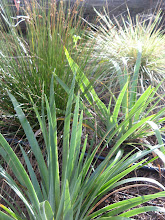
Native californians have been gardening with california plants for thousands of years. Hmm, maybe I could tap into that knowledge to the benefit of the land and myself.
I've already mentioned coppicing, but how about cultivation practices that improve berry production, seed germination, mushroom production, and what else? (And reducing fire loads in our forests). Knowing when and how much to take. AND how to encourage native biodiversity. I really have everything to learn.
Kat Anderson's "Before the Wilderness" is a book about this idea on a larger, land management level. Haven't read it yet, but it's at my library and hopefully I can get to it this week.
This is one of the most radical and potentially beneficial gardening ideas I can think of. It would strengthen the human/nature relationship and put deeper meaning into a garden.
At least one of the gardeners at Gardener Rant (see link at far right) rants about the idea of the "yardeners," I'm guessing those that want a no maintenance yard, instead of a garden they are actively engaged with. Well, maybe the ornamental garden isn't that far ahead of a "yarden." Maybe the next step would be to pretend there is no fence around our garden and plug our garden into the larger landscape. Blend the line between cultivated and noncultivated a bit. Maybe this is a way that nonnatives, like recent human migrants, broccoli, and what not, can become native. I don't know, these are just the beginnings of thoughts.
Sunday, September 30, 2007

Saturday, September 29, 2007
Coastal Prairie
One of the best things about fall is that the sun becomes just a bit lower, making the lighting (and backlighting) more dramatic. Ok, so the two following photos are taken late in the day, around five. Below are Clarkia amoena and Coastal Hairgrass (Deschampsia caespitosa).
 This is a view of our "coastal prairie" in the front of the house, viewed from the stairway. Sorry the photo is so dark. I think it's coming together nicely, but needs some more green, so that it blends in better with the surrounding forest, and so the flowers are more noticable. I think I'll rely on the short soft mystery sedge and springbank clover for ground cover.
 This is a view of our "coastal prairie" in the front of the house, viewed from the stairway. Sorry the photo is so dark. I think it's coming together nicely, but needs some more green, so that it blends in better with the surrounding forest, and so the flowers are more noticable. I think I'll rely on the short soft mystery sedge and springbank clover for ground cover.
 Below you can see the Coastal Hairgrass (Deschampsia caespitosa) that I coppiced, in front of one that I haven't. See all the bright green? That's what I'm going for. I'm excited about the materials I'm gathering from pruning the grasses and graminoids, because they'll make an excellent mulch for other areas. Cutting the grasses down will also expose the soil to more sunlight, easing wildflower germination this spring.
 I'm going to wait till early spring before cutting some of the hairgrass back because their inflorescences are interesting, especially with that autumn light.

Monday, September 24, 2007
Pruning Tips from Las Pilitas
I have never been to Las Pilitas, the native nursery down in Southern California, but I really like their website. Whoever is writing the text is doing a great job. It is extremely opiniated and no-nonsense. I can't personally attest to what they recommend, because I haven't tried out most of it, but when it's said so confidently it certainly makes me want give their methods a try. (And I'm aware that not all of the methods can be applied to Humboldt County, it is radically different than San Diego. On the other hand, some of their species are our species.) But what are their methods? Take a look at their pruning tips, for a start.
Lonicera involucrata involucrata
I had to make this photo a giant so you can see the swollen nectaries at the base of these flowers. Must be for hummingbirds, butterflies, or both. Don't these flowers look like two femurs attached to a pelvis? It's called twinberry honeysuckle (Lonicera involucrata involucrata). Twinberry because the flowers will swell at the base to become two dark shiny berries, side by side. The fused bracts (or involucre--notice scientific name) that the flowers are sitting on will become deep red.

They are bizzare, but also beautiful at the right angle.

They are bizzare, but also beautiful at the right angle.

But like many interesting flowers, you've got to look closely to fully appreciate them. They are easy to overlook.

Yep, it's a Humboldt County native from the backyard.
Wednesday, September 19, 2007
Work Thoughts
These are just some random, and somewhat obvious, thoughts I've had while working at the nursery. (Many thoughts have had to be cut. I'm trying to stay positive here.)
Skunk cabbage has a tuberish thing with long roots that are mostly unbranched, rubbery things that have rings like annelids, but more closely spaced. Reminds me of mandrake (isn't that the screaming plant in the first Harry Potter movie?).
Weed pots, especially weed out alders and willows before they become full size trees! The trees can be salvaged, but the root systems are bound and usually lopsided, while the intentional plant is nearly dead or dead.
Wind barriers are very important at a nurery with trees. Stakes are important too, but make sure you don't buy stakes that need support themselves. Oh and invent something that will keep treepots reliably upright. Unless you are going for bonsai materials, don't let young trees grow crooked. And nearly all trees should be single-trunked, if you ever want to sell them.
Soil sterilizer, I wish I had one. But is there not a low-tech alternative? My faith in the composting process isn't that strong. I have a compost pile that I completely neglect. Composting is a real weakness of mine!
Seed propagation. It surely must be the noblest form of propagation. Must become a seed master. I do not like wild collecting, especially on a large scale, especially for profit. I don't mind taking a snip here or a seed capsule there.
Wouldn't it be cool to have woven old-english stlye fences everywhere? With a hedge of wild roses and hazels behind it? And geese running around keeping the grass down? Old England meets native California culture and plants. This is the Garden of La Mancha.
Organization on the grounds and in the books is "importante" for a business. So are clean, sharp, tools. Yes tools. You know, I really would like a scythe. Why don't we use them anymore? I also would like a pruning knife. And a watering can with a rose attachment.
All by-products need to become products. When I coppice my grasses and rushes this year I'll have native straw for mulch. Some of the "weeds" (only the natives) can be potted up. Things must be reused. Close the loop!
Skunk cabbage has a tuberish thing with long roots that are mostly unbranched, rubbery things that have rings like annelids, but more closely spaced. Reminds me of mandrake (isn't that the screaming plant in the first Harry Potter movie?).
Weed pots, especially weed out alders and willows before they become full size trees! The trees can be salvaged, but the root systems are bound and usually lopsided, while the intentional plant is nearly dead or dead.
Wind barriers are very important at a nurery with trees. Stakes are important too, but make sure you don't buy stakes that need support themselves. Oh and invent something that will keep treepots reliably upright. Unless you are going for bonsai materials, don't let young trees grow crooked. And nearly all trees should be single-trunked, if you ever want to sell them.
Soil sterilizer, I wish I had one. But is there not a low-tech alternative? My faith in the composting process isn't that strong. I have a compost pile that I completely neglect. Composting is a real weakness of mine!
Seed propagation. It surely must be the noblest form of propagation. Must become a seed master. I do not like wild collecting, especially on a large scale, especially for profit. I don't mind taking a snip here or a seed capsule there.
Wouldn't it be cool to have woven old-english stlye fences everywhere? With a hedge of wild roses and hazels behind it? And geese running around keeping the grass down? Old England meets native California culture and plants. This is the Garden of La Mancha.
Organization on the grounds and in the books is "importante" for a business. So are clean, sharp, tools. Yes tools. You know, I really would like a scythe. Why don't we use them anymore? I also would like a pruning knife. And a watering can with a rose attachment.
All by-products need to become products. When I coppice my grasses and rushes this year I'll have native straw for mulch. Some of the "weeds" (only the natives) can be potted up. Things must be reused. Close the loop!
Tuesday, September 18, 2007
Blooming
I missed Bloom Day, but here are some of plants flowering in the yard right now.
Springbank Clover
 Mimulus aurantiacus with culms of Deschampsia caespitosa
Springbank Clover

Annuals: white phlox (can't remember the name at the moment) with pink Clarkia amoena
 Mimulus aurantiacus with culms of Deschampsia caespitosa
 Hedge Nettle (Stachys sp.), a volunteer.
 Sisyrinchium bellum. I have to hold up the flowers because they flop over, sadly.
Sunday, September 16, 2007
The Righteous Garden
This gardener fights for the right and struggles to find out what "right" means. It's not easy, but this is my quest. And there are somethings I'm able to grasp as being right and good.
These include: Gratitude, Diversity, and Hope. The idea of diversity pops up over and over again in my life and has led me to some conclusions about life that can, of course, be applied to the garden.
Things to Apply to Your Garden.
Native Plant gardeners are often accused of being self-righteous and sometimes xenophobic. And maybe some of us are, and maybe part of me is. But I'm cautious of falling into these categories, and that says something. I can't speak for all native plant gardeners, so I'll speak only for myself.
Like I've said, I believe in diversity. In culture and in ecology. It's good to have as many angles as possible so that we can carve out truths. (I choose to believe in truths, call me a modernist. I choose to believe in diversity, call me a postmodernist). And a wide range of ideas keeps our culture running smoothly and gives us options. But beyond all the practical reasons for salvaging and creating diversity, the need, beyond these reasons I want diversity. It keeps life interesting.
The Garden of La Mancha prioritizes thus:
3. Beauty--is that well-tended garden with wild corners. Beauty will be expressed as much as possible with edible and native plants. Non-native, non-food producing ornamentals, will be chosen with great care and must be absolutely irresistable to be included in the garden.
These include: Gratitude, Diversity, and Hope. The idea of diversity pops up over and over again in my life and has led me to some conclusions about life that can, of course, be applied to the garden.
Things to Apply to Your Garden.
Native Plant gardeners are often accused of being self-righteous and sometimes xenophobic. And maybe some of us are, and maybe part of me is. But I'm cautious of falling into these categories, and that says something. I can't speak for all native plant gardeners, so I'll speak only for myself.
Like I've said, I believe in diversity. In culture and in ecology. It's good to have as many angles as possible so that we can carve out truths. (I choose to believe in truths, call me a modernist. I choose to believe in diversity, call me a postmodernist). And a wide range of ideas keeps our culture running smoothly and gives us options. But beyond all the practical reasons for salvaging and creating diversity, the need, beyond these reasons I want diversity. It keeps life interesting.
The Garden of La Mancha prioritizes thus:
1. Food--the best way to be happy and responsible is to provide for oneself as much as possible. Heirloom varieties are preferable for agricultural diversity's sake.
2. Natives--the best way to keep the local biodiversity going.3. Beauty--is that well-tended garden with wild corners. Beauty will be expressed as much as possible with edible and native plants. Non-native, non-food producing ornamentals, will be chosen with great care and must be absolutely irresistable to be included in the garden.
4. The garden should never be static. There will always be new projects and experiments. So plants will come and go. It will be an ecosystem with successions within successions and some disturbances.
Perhaps the heirarchy is more like a food pyrimad, with edibles on the bottom, natives in the middle, and eye-candy on top. (Too much variegated and colorful foliage, and too many gawdy flowers gross me out). Of course, if you have a lot of land, you may want to let more of it grow wild.
To me, the thoughts that a plant is useful or native adds beauty to it. It's similar to how heavy whole wheat bread tastes better to me becuase of the thought that it is good for me. This is why a native plant with a few holes in the leaves is more beautiful, than the invasive gawdy non-native plant down the street.
Never invasive non-natives.
Subscribe to:
Posts (Atom)